Ask your money, anything.
Treasury tracks everything, finds what matters, and shows how to make your money go further.
Budgets
Tuesday, Mar 24
Good afternoon, Penny
Net Worth
$148,726.43
📈 Road to Riches
Recent
 Whole Foods $72.30
 Uniqlo $48.00
 Monorail Espresso $5.40
Upcoming
 Safeway $85.00
 Spotify $12.99
 REI $249.00
You could be leaving $0 a year on the table.
Treasury connects the dots across your financial life to surface opportunities traditional finance apps never look for.
How we know — every number, sourced
- Wrong card for dining out (+$310/yr) — Your everyday card earns 1x at restaurants; a dining card earns up to 4x. On ~$6,000 a year of eating out, that's roughly 18,000 points — about $310 — left behind. Top dining rewards cards (2025)
- Selling winners before a year (+$1,350/yr) — A stock held under a year is taxed as ordinary income (24%) instead of the 15% long-term rate — a 9-point gap. On $15,000 of gains, that is $1,350. IRS Topic 409 — capital gains rates
- Subscriptions you don't use (+$205/yr) — The streaming tiers and apps you forgot about, still billing monthly. CNET subscriptions survey, 2025
- Ignoring your corporate rental rate (+$400/yr) — Your employer's negotiated car-rental rate runs ~20% below retail, plus waived fees and free upgrades. Across a year of rentals, ~$400 overpaid. Corporate travel car-rental discounts
- HSA left unmaxed (+$1,056/yr) — Filling your HSA to the 2026 limit of $4,400 is a deduction worth $1,056 at your 24% marginal rate — before tax-free growth. IRS 2026 HSA limit ($4,400) at 24% marginal rate
- Haven't re-shopped car insurance (+$461/yr) — Same coverage, wildly different prices. Drivers who compare and switch save a median of $461/yr. Consumer Reports auto-insurance survey
- Cashing points at a penny each (+$1,100/yr) — Redeemed for cash, points are worth about 1 cent; transferred to airline partners they are often 2-5 cents in premium cabins. On your balance, $1,000+ of travel goes unclaimed. The Points Guy monthly point valuations
- Never harvesting tax losses (+$1,020/yr) — Selling losers banks the loss — it offsets capital gains plus up to $3,000 of ordinary income a year. At your rate, ~$1,000 back, and unused losses carry forward. IRS Topic 409 — capital losses
- Skipping your Alaska status match (+$720/yr) — Your work travel qualifies you for an Alaska status match — free checked bags ($35 each) and upgrades you pay for instead. Across a year of trips, ~$720. Alaska Airlines status match; baggage fees
- $40k sitting idle in checking (+$1,572/yr) — $40,000 in checking earns 0.07%; a high-yield account pays ~4% for the same safety. The gap is real money each year. Federal Reserve household cash data; HYSA vs. checking rates
- Never enrolled in the ESPP (+$2,500/yr) — A 10% discount on up to $25,000 of stock is a guaranteed 10% return the day you buy. You are not enrolled. Microsoft Employee Stock Purchase Plan
- Skipped your employer gift-match (+$2,000/yr) — Microsoft matches employee donations dollar-for-dollar up to $15,000/yr. You gave $2,000 and never filed the match. Microsoft Employee Giving Program
- Only catching half your 401(k) match (+$6,250/yr) — Microsoft matches 50% of contributions up to the $24,500 IRS limit — a full $12,250. You contribute 6% (~$12k), so you claim only $6,000. Microsoft 401(k) Plan + IRS 2026 limits
- Mega Backdoor Roth — Microsoft lets you shelter up to $35,250/yr more, tax-free; unused, that's $3M+ in tax-free growth over a career.
- Backdoor Roth IRA — at $200k you're locked out of a direct Roth, but the backdoor is open: $7,500/yr you aren't sheltering.
- Lifetime — the $18,944/yr total, invested at a 7% nominal return over 30 years, compounds to roughly $1.79M.
For every financial question
Your complete financial picture. In one place.
From everyday spending to long-term planning, Treasury brings everything together.
Tue, Mar 3, 2026
 A A W
A A WYour money, on autopilot
Know where every dollar goes, automatically.
Your accounts, spending, plans, and recurring charges stay organized as they change, so every money decision starts with the full picture.
Budget for what's next.
Create separate budgets for the life you're building, then see where each one stands as you spend.
Know your net worth at a glance.
Checking, savings, investments, and credit, together in one picture that stays current with your accounts.
Net Worth
$48,382.50
+$10,182.50 (+26.7%) Past 6 Months
 Chase Total Checking $51,230.00
 Wells Fargo Active Cash $1,847.50
 Capital One Savor $1,000.00
See what's on repeat.
Recurring charges and their monthly total, in one place, so you can decide what still earns its spot.
Spotify Premium $12.99/mo Adobe Creative Cloud $54.99/mo
 Google One $2.99/mo
 Gym Membership $45.00/mo
Transactions, sorted your way.
Treasury categorizes new spending as it arrives. Correct it once, and it learns how you want to see it.
Whole Foods — $82.43 Spotify — $12.99 Alaska Airlines — $347.00 Safeway — $24.17 REI — $45.32
Independently scored
We tested the best money apps. Treasury won every category.
Same accounts, same questions, graded by an independent AI judge. Treasury came first in all 12 categories. Treasury was measured August 2026, the others June 2026.
| Measure | Treasury | Origin | Monarch |
|---|---|---|---|
Grounding | 94 | 76 | 51 |
Correctness | 91 | 75 | 57 |
Resolution | 85 | 68 | 48 |
Prudence | 89 | 75 | 59 |
Overall | 89 | 71 | 52 |
Dangerous answers | 0 | 4 | 9 |
Time to answer | 11.6s | 46s | 101s |
Every app answered with the same connected accounts and the same transaction history, so this is a difference in the quality of the advice, not in what each one could see.
Wherever you are
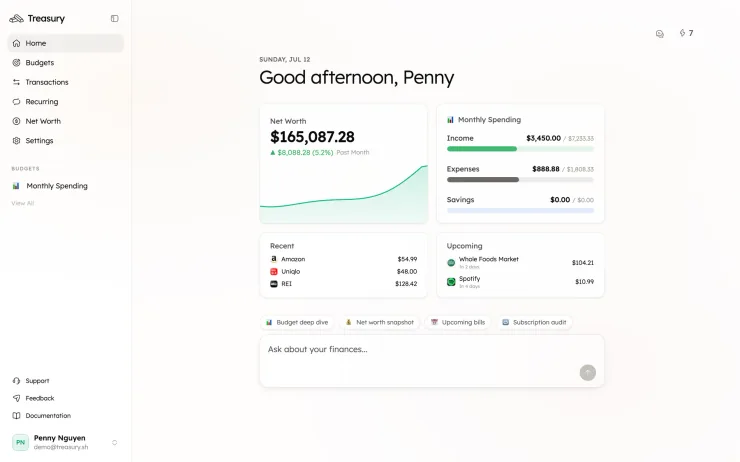
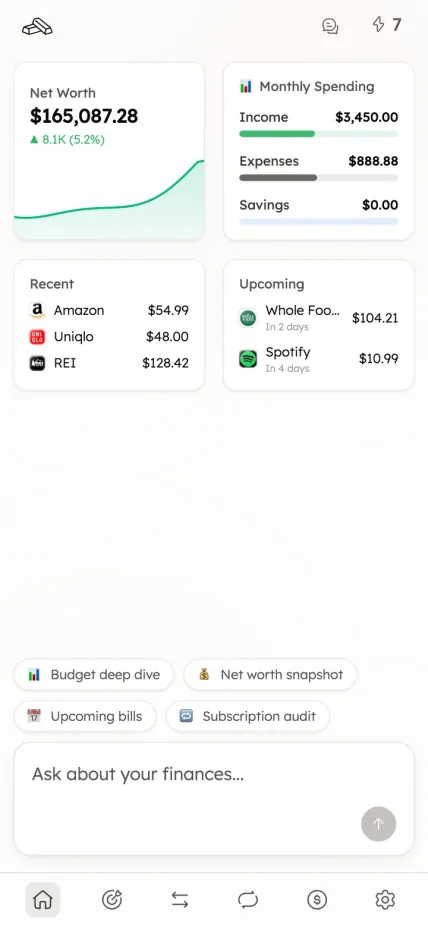
Start on your phone. Finish on your laptop.
Phone, tablet, laptop, or the web — one Treasury, always in sync, so you pick up right where you left off.
Your data stays yours
Safe with us. Always Private.
Connecting your accounts should feel safe. Treasury reads your money without ever touching it, guards everything with bank-level encryption, and keeps what it learns private to you.
Read-only, always
Treasury can see your transactions, but can never move, send, or spend a dollar.
Your login stays private
You sign in through Plaid, so your bank password stays with your bank — never on our servers.
Encrypted and yours
Bank-level 256-bit encryption in transit and at rest, and your data is never sold.
Don't take our word for it
The last finance app you'll ever download.
Mint. YNAB. Copilot. Spreadsheets — then they found Treasury.
4.7
App Store rating
Loved by users in 30 states
and counting
Trusted by employees at
and more
FINALLY REPLACED THE SPREADSHEET
"I used Rocket Money for a year and maintained a spreadsheet alongside it because neither was enough on its own. Treasury replaced both. One place, everything connected, nothing to maintain. I've tried everything — nothing comes close."
Yazan A.
Founder
"Every budgeting app I've tried turned into a second job — fixing wrong categories, correcting errors, fighting the interface. Treasury is the first one that just works. The categories are right. The interface gets out of the way. I actually budget now instead of maintaining an app."
Sana N.
Tried 5+ apps before Treasury
"Most budgeting apps tell you how to manage your money. Treasury shows you exactly where it's going and lets you decide what to do with that information. It's the flexibility of a spreadsheet without the maintenance. I'm finally making decisions based on real data instead of guesses."
Colin F.
Switched from spreadsheets
"The first thing that sold me was that Treasury doesn't sell your data. In a world where every free app is monetizing your financial behavior, paying for something that's genuinely on your side feels different. And then the app itself is actually beautiful and easy to use. Both things at once — rare."
Madeline L.
Privacy-first user
One simple plan
Every day without Treasury is money left on the table.
Missed cash-back, idle savings, forgotten subscriptions, tax you didn't need to pay — it quietly adds up to far more than you'd think.
Treasury finds it — from $7.92 a month.
$7.92/month equivalent · Save $61 a year
“Found $115 in forgotten subscriptions on day one. Paid for itself before my first month was up.”
Haroon N. · Dentist · Switched from Monarch
14-day free trial · Cancel anytime
Worth every cent
Why pay for a finance app?
A financial advisor runs $200–$400 an hour and books out for weeks. Treasury answers the same money questions for $7.92 a month — any time you ask.
Financial advisor
$2,400+
a year, if you can get one
Treasury
$95
a year, everything included
* Advisor rate $200–$400/hr per the 2024 Kitces Report; ~8 planning hours a year.
It pays for itself
Members routinely find more in missed rewards, hidden fees, and forgotten subscriptions than Treasury costs — often in the first month.
Everything included
The AI advisor, budgets, net worth, and every feature at one flat price. No tiers, no add-ons, no upsells.
You're the customer, not the product
No ads and nothing to sell you. Treasury answers to you, not to advertisers.
Common questions
Questions? Answers.
Getting started
Security & privacy
Billing

Ready when you are
Clarity that compounds. Start building it today.
Your whole financial life in one place, quietly working for you.
14-day free trial · Cancel anytime